6 Best Handheld Carbon Monoxide Detectors (November 2026)
The best handheld carbon monoxide detectors include the Kidde Carbon Monoxide Detector for outlet-based home coverage, the Kidde Carbon Monoxide Detector for battery-powered placement, and the TOPTES CT-580 Portable Carbon Monoxide Detector for handheld CO spot checks.
On this page (5 sections)
The best handheld carbon monoxide detector for spot checks is the TOPTES CT-580, a rechargeable portable instrument with a display and audible, visual, and vibration alarms. For ongoing home monitoring, choose a household CO alarm rather than relying on a handheld device.
Carbon monoxide is dangerous because you can't see or smell it. A portable instrument can help you check different locations, but it doesn't replace properly placed household alarms or emergency action if an alarm sounds.
If you're choosing an alarm for a home, start with what a smoke alarm does, then consider a CO alarm made for fixed residential use. For work across commercial spaces, see our guide to the best carbon monoxide detector for industrial use.
Our picks at a glance
-
1
 Best for outlet-based home coverage
Kidde Carbon Monoxide Detector
9.7/10 our score
See it on Amazon -
2

-
3
 Best for handheld CO spot checks
TOPTES CT-580 Portable Carbon Monoxide Detector
9.3/10 our score
See it on Amazon
- 4
 Check it
Siterlink Carbon Monoxide Detectors Plug
Best for plug-in use with long backup - 5
 Check it
Heiman Carbon Monoxide Detectors
Best for a display on a portable alarm - 6
 Check it
TopTes S2 Multi Natural Gas Detector
Best for checking CO and combustible gas
How we chose these handheld carbon monoxide detector picks
The TOPTES CT-580 is the closest match for someone searching for a handheld CO detector because it is described as a manual inspection tool. The other picks are portable in different ways, but most are household alarms rather than handheld meters.
We compared each option by its stated job, power source, display or alarm features, and any limits that affect placement. A product's score reflects how well those details fit the reader's likely need, along with the available buyer feedback.
Our score weighs specs, features and buyer feedback against what you're shopping for. We did not test these products in person, so the descriptions below stick to stated features and practical fit.
A commercial carbon monoxide detector may have different needs from a household alarm or a pocketable meter. HVAC technicians can also compare options in our guide to a carbon monoxide detector for HVAC work.
| Product | Best for | Power | Alarm | Use | Our score |
|---|---|---|---|---|---|
| Kidde Carbon Monoxide Detector | outlet-based home coverage | 120V AC with 2 AA backup batteries | Audible and visual | Residential CO monitoring | 9.7 |
| Kidde Carbon Monoxide Detector | battery-powered placement | 2 AA batteries | Audible and visual | 9.5 | |
| TOPTES CT-580 Portable Carbon Monoxide Detector | handheld CO spot checks | Portable manual inspection tool | 9.3 | ||
| Siterlink Carbon Monoxide Detectors Plug | plug-in use with long backup | AC with built-in battery backup | 9.2 | ||
| Heiman Carbon Monoxide Detectors | a display on a portable alarm | 2 AA batteries | 8.6 | ||
| TopTes S2 Multi Natural Gas Detector | checking CO and combustible gas | Portable spot checking | 8.5 |
The best handheld carbon monoxide detectors and portable alarms
The CT-580 is the dedicated spot-check pick, while the Kidde and other models here suit household alarm coverage with portable or flexible placement. Match the device to the job before deciding which features matter most.
Kidde Carbon Monoxide Detector: Best for outlet-based home coverage
- 120V AC plug-in
- 2 AA battery backup
- 85 dB alarm
- Rotating plug
A plug-in alarm with battery backup suits a home outlet where you want ongoing CO monitoring. Its rotating plug fits vertical or horizontal outlets.
Pros
- Backup batteries included
- Rotating plug
- 10-year limited warranty
Cons
- Needs an outlet for normal operation
- Not approved for RV or boat use
The Kidde COP is a household alarm, not a handheld inspection meter. Its rotating plug fits vertical or horizontal outlets, and 2 included AA batteries provide backup during power outages.
It monitors CO levels and uses an 85 dB alarm with an LED warning light. A Test/Hush button supports quick checks, while the 120V AC plug-in design suits a home outlet.
Kidde says the alarm meets UL 2034 5th Edition standards and is ETL listed, with a 10-year limited warranty. Its travel-ready description includes a clear restriction: it is not approved for RV or boat use.
Choose it for a fixed residential location where plug-in power is convenient. If you need to carry a meter from room to room to inspect readings, the CT-580 is a closer match.
Kidde Carbon Monoxide Detector: Best for battery-powered placement
- 2 AA batteries
- Wall mount or tabletop
- 85 dB alarm
- Travel-ready design
This battery-powered household alarm can be placed on a table or mounted on a wall without wiring. It suits rooms where an outlet is not convenient.
Pros
- No wiring needed
- Wall or tabletop placement
- 10-year limited warranty
Cons
- Not a manual inspection instrument
- Not approved for RV or boat use
The Kidde COB gives you a battery-powered household alarm that doesn't need wiring or an outlet. You can mount it on a wall or set it on a table, which makes placement more flexible than a plug-in unit.
It uses 2 included AA batteries and provides an 85 dB alarm, LED warning light, and Test/Hush button. The alarm is intended to signal occupants to move to fresh air when it detects raised CO.
Kidde says this model meets UL 2034 5th Edition standards and is ETL listed, with a 10-year limited warranty. Like the plug-in Kidde, it's described as suitable for travel but is not approved for RV or boat use.
Pick this model when you want a household alarm that can operate during an outage without depending on a plug. It doesn't provide the live reading display expected from a manual inspection instrument.
TOPTES CT-580 Portable Carbon Monoxide Detector: Best for handheld CO spot checks
- Rechargeable with USB-C
- 0 to 1000 PPM range
- Audible, visual, and vibration alarms
- Protective case included
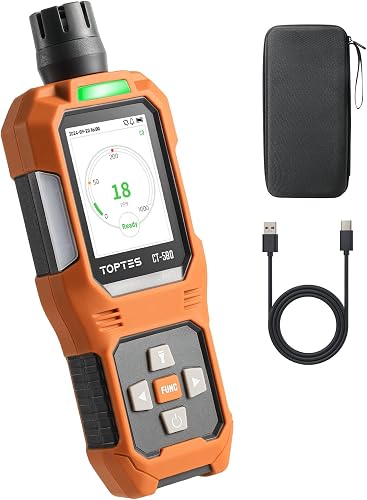
The CT-580 is a portable tool for checking CO at different locations. Its display, three alarm modes, and rechargeable design fit spot-checking needs.
Pros
- Three alarm modes
- Adjustable screen brightness
- Built-in flashlight
Cons
- Not a fixed 24/7 household alarm
- Rechargeable battery needs charging
The TOPTES CT-580 is the clearest fit for a handheld carbon monoxide detector because it's a manual inspection tool for checking changing conditions. It measures from 0 to 1000 PPM and has a graphical display.
Its three alarm modes use an indicator light, sound, and vibration. The rechargeable design has USB-C charging, adjustable screen brightness, auto screen-off, and a built-in flashlight.
TOPTES describes the CT-580 as suitable for personal and business use, with menu options that include alarm history and zero and standard gas calibration settings. It comes with a protective case, charging cable, and user manual.
Choose this model to carry out spot checks across locations. The available information doesn't describe it as a continuous household alarm, so keep suitable fixed CO alarms in place as well.
Siterlink Carbon Monoxide Detectors Plug: Best for plug-in use with long backup
- AC plug-in
- 10-year battery backup
- Foldable plug
- Electrochemical sensor
This outlet alarm combines AC power with a stated 10-year battery backup. Its foldable plug can make it easier to pack for travel.
Pros
- Battery backup for outages
- Foldable plug
- Compact travel design
Cons
- Designed as an alarm, not a manual inspection tool
- Specific alarm modes are not described
The Siterlink is a plug-in alarm with a 10-year battery backup, making it a flexible choice for a home outlet and power outages. Its foldable plug is also described as travel-friendly.
This is an alarm rather than a manual inspection meter. Its electrochemical sensor detects CO, and a soft green status light indicates a stable power supply.
The compact design may suit hotel or home use where an outlet is available. Check the device instructions for placement and use, and don't assume its travel design makes it suitable for every vehicle or outlet type.
Choose it if you want an outlet alarm with long battery backup. For checking readings across multiple locations, the CT-580 is designed for that manual task.
Heiman Carbon Monoxide Detectors: Best for a display on a portable alarm
- Live CO display from 20 PPM
- 20 to 999 PPM measuring range
- 2 AA batteries
- Tabletop or wall mount
A real-time display and battery power make this compact alarm useful when you want to see readings as well as hear alerts. It's intended for residential spaces.
Pros
- Shows live readings
- No outlet or wiring needed
- Includes wall mounting hardware
Cons
- Not for garages or workshops
- Operating range is 40°F to 100°F
The Heiman combines a real-time LCD with a battery-powered residential CO alarm. Its display shows readings starting at 20 PPM, with a stated measuring range of 20 to 999 PPM.
It runs on 2 AA batteries and can sit on a tabletop or mount on a wall. Its alert system includes a 30 PPM early warning, an 85 dB danger alarm, and 12-hour alarm memory.
Heiman describes this model for residential use and specifically says not to use it in garages or workshops, or directly under vehicle exhaust. The stated operating range is 40°F to 100°F, so placement outside that range may affect performance.
Choose it if a visible reading is useful alongside an alarm. It is still a residential alarm, not a substitute for a portable instrument intended for repeated manual checks.
TopTes S2 Multi Natural Gas Detector: Best for checking CO and combustible gas
- Detects CO and combustible gases
- Extendable 6.5 in probe for combustible gas checks
- Rechargeable
- Visual and audible alarms
The S2 Multi checks carbon monoxide and combustible gases with one portable device. It is intended for spot checks, not continuous monitoring.
Pros
- Checks multiple gas types
- Extendable probe for combustible gas
- Protective case included
Cons
- Not for continuous 24/7 monitoring
- Needs a 30-second warm-up in clean air
The TopTes S2 Multi is useful when you want to spot-check carbon monoxide and combustible gases with one portable device. It shows CO readings from 0 to 999 PPM, along with combustible gas readings from 0.1 to 20% LEL.
Its extendable 6.5 in probe is for checking narrow gaps for combustible gas leaks. The device also has a rechargeable battery, color LCD, and audible and visual alarms.
The S2 Multi needs 30 seconds to warm up in clean air before detection. TopTes states that it's for portable spot checks and is not intended for continuous, 24/7 fixed monitoring.
Choose it when checking both CO and combustible gas is useful. For CO-only spot checks, the CT-580 has a more direct focus.
Is there a handheld carbon monoxide detector for travel?
Yes, some portable CO instruments and household alarms are designed to be carried, but their intended jobs differ. The CT-580 is a manual spot-check tool, while the Kidde battery model is a household alarm that can be wall mounted or set on a table.
Check the manufacturer's instructions before travel, especially for use in vehicles or unfamiliar outlets. Kidde says its travel-ready models are not approved for RV or boat use, and the S2 Multi is a spot-check device rather than a continuous alarm.
If you want a combination unit for household smoke and CO warning, compare our picks for the best X-Sense smoke and CO detector. For a separate smoke alarm, see the best First Alert smoke and fire alarm.
What should you check before buying a handheld CO detector?
Choose a handheld instrument if you need to take readings at different places. A household alarm is a better fit for continuous warning in a room or home.
Check these details before you choose:
- Intended use: Look for clear instructions on spot checks versus continuous monitoring.
- Readout: A display can show a measurement, while an alarm alone may only signal a threshold.
- Alarm type: Sound, lights, and vibration can help in different work settings.
- Power: Rechargeable, AA battery, and AC-powered options serve different routines.
- Operating limits: Temperature, placement, and warm-up guidance can affect use.
- Other gases: A multi-gas device adds capabilities, but its probe and readings may apply to different gases.
Don't treat a portable device as the only safety measure in a home. Use household CO alarms according to their instructions, and leave an area and seek help if an alarm warns of danger.
For more on household alarms, read about the difference between a smoke detector and fire alarm. If you are planning connected smoke alarms as well, see our guide to wireless interconnect smoke detectors.
Which handheld carbon monoxide detector should you choose?
Choose the TOPTES CT-580 if you need a portable tool for manual CO spot checks, or the TopTes S2 Multi if you also want combustible-gas readings. For ongoing home warning, choose a household alarm such as a Kidde model and follow its placement instructions.
A handheld carbon monoxide detector helps you inspect different locations, while a fixed alarm watches its assigned area over time. Pick the device by the job, and keep the two roles clear.
Our top 3 picks at a glance
-
1
Best for outlet-based home coverage
Kidde Carbon Monoxide Detector
9.7/10 our score
See it on Amazon -
2
-
3
Best for handheld CO spot checks
TOPTES CT-580 Portable Carbon Monoxide Detector
9.3/10 our score
See it on Amazon
Frequently asked questions
Is there a handheld carbon monoxide detector?
Yes. A handheld carbon monoxide detector such as the TOPTES CT-580 is designed for manual checks in different locations.
It has a display and audible, visual, and vibration alarms.
A portable spot-check tool serves a different purpose from a household alarm intended for ongoing protection.
Can a portable CO detector replace a home alarm?
No. A portable inspection tool is meant for checks when you use it, while a household CO alarm is intended for ongoing monitoring in its installed location.
Use alarms in the locations recommended by their instructions, and treat a handheld meter as an additional tool.
What should I compare in handheld carbon monoxide detector reviews?
Compare the device's intended use, measurement range, display, alarm types, power source, and whether it is designed for continuous monitoring. Also check operating limits and warm-up instructions.
A multi-gas tool may add combustible-gas readings, but that does not make it a replacement for fixed alarms.
How is a portable CO meter different from a household CO alarm?
A portable meter is carried from place to place for manual checks. A household alarm stays in a suitable location and monitors continuously.
Choose based on the job: use a portable instrument to investigate readings across locations, and install household alarms for ongoing warning.


