6 Best Carbon Monoxide Detector for Camping (November 2026)
The best portable carbon monoxide detectors for camping include the Kidde Carbon Monoxide Detector for simple battery-powered camping checks, the Kidde Carbon Monoxide Detector for campsites with 120V access, and the TOPTES CT-580 Portable Carbon Monoxide Detector for handheld campsite inspections.
On this page (6 sections)
- The best carbon monoxide detector for camping setups
- How do you choose a portable carbon monoxide detector for camping?
- How should you set up a carbon monoxide detector at camp?
- How do you store and transport a camping CO detector?
- Should you buy more than one carbon monoxide detector?
- Verdict: which carbon monoxide detector for camping should you choose?
The best carbon monoxide detector for camping is the TOPTES CT-580 for campers who want a rechargeable detector with a display and vibration alerts. The Kidde COB is the simpler battery-powered choice, while the TOPTES CT-913 is better for extended trips because it runs for over 60 hours on one charge.
Carbon monoxide is colorless and odorless, so you cannot use smell to judge whether a camping area is safe. For detectors intended for RV use, see carbon monoxide detectors for RVs.
A portable CO detector can add an alert near an enclosed cabin, RV, or other suitable camping space, but safe fuel handling and ventilation remain essential.
If you are comparing camping equipment for a vehicle, see our guide to the best carbon monoxide detector for car. For broader vehicle setups, our guide to the best carbon monoxide detector for vehicles covers the differences.
Our picks at a glance
-
1
 Best for simple battery-powered camping checks
Kidde Carbon Monoxide Detector
9.5/10 our score
See it on Amazon -
2
 Best for campsites with 120V access
Kidde Carbon Monoxide Detector
9.4/10 our score
See it on Amazon -
3
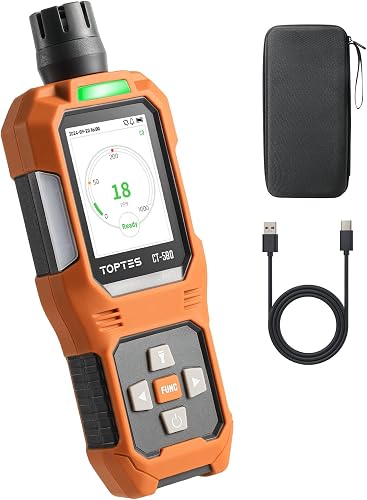 Best for handheld campsite inspections
TOPTES CT-580 Portable Carbon Monoxide Detector
9.3/10 our score
See it on Amazon
- 4
 Check it
Heiman Carbon Monoxide Detectors
Best for long-term battery life - 5
 Check it
Heiman Carbon Monoxide Detectors
Best for low-level CO readings - 6
 Check it
TOPTES CT-913 Portable Carbon Monoxide Detector
Best for extended rechargeable runtime
The best carbon monoxide detector for camping setups
The TOPTES CT-580 is the best overall fit for temporary camping use because it combines rechargeable power, a readable display and three alarm modes. The other picks suit campers who value simple AA batteries, a plug-in design, low-level readings or longer battery runtime.
Our score weighs specs, features and buyer feedback against what you are shopping for. We checked portability, power, alert style, display information and the type of camping setup each detector can reasonably support.
| Product | Best for | Power | Size | Weight | Our score |
|---|---|---|---|---|---|
| Kidde Carbon Monoxide Detector | simple battery-powered camping checks | 2 included AA batteries | 1.52 x 5.14 x 2.83 in | 5.92 oz | 9.5 |
| Kidde Carbon Monoxide Detector | campsites with 120V access | 120V AC with 2 AA battery backup | 1.52 x 5.47 x 5.47 in | 9.4 | |
| TOPTES CT-580 Portable Carbon Monoxide Detector | handheld campsite inspections | Rechargeable battery with USB-C charging | 9.3 | ||
| Heiman Carbon Monoxide Detectors | long-term battery life | Battery powered | 2.75 x 1.45 x 2.75 in | 8.8 | |
| Heiman Carbon Monoxide Detectors | low-level CO readings | 2 AA batteries, not plug-in | 8.6 | ||
| TOPTES CT-913 Portable Carbon Monoxide Detector | extended rechargeable runtime | Rechargeable battery with USB-C charging | 8.3 |
1. TOPTES CT-580 Portable Carbon Monoxide Detector: Best for handheld campsite inspections
TOPTES CT-580 Portable Carbon Monoxide Detector: Best for handheld campsite inspections
- 0–1000 PPM range
- Rechargeable USB-C power
- TFT color display
- Audible, visual and vibration alarms
The CT-580 is a handheld inspection tool with a 0–1000 PPM range, TFT color display and three alarm modes. Rechargeable USB-C power makes it practical when you want to carry one detector between camping areas.
Pros
- Vibration alert
- Color display
- Protective case included
Cons
- Requires charging
- More controls than a basic alarm
The TOPTES CT-580 is the strongest match for campers who want more information than a basic alarm provides. It measures carbon monoxide from 0 to 1000 PPM and uses a TFT color display for readings and menu options.
Its three alarm modes are a light, an audible alarm and vibration. All three activate together when the CO concentration reaches the alarm threshold, which helps when you are outdoors, moving around a campsite or wearing hearing protection.
The rechargeable design uses USB-C charging. The CT-580 also has adjustable screen brightness, auto screen-off, a built-in flashlight and a protective case.
The box includes the detector, Type-C charging cable, protective case and user manual.
This is a handheld inspection tool rather than a small wall alarm. Choose it when you want to check changing conditions around a camping setup and read a number on the screen.
Its extra controls may be more than you need if your only goal is a simple warning.
2. Kidde Carbon Monoxide Detector: Best for simple battery-powered camping checks
Kidde Carbon Monoxide Detector: Best for simple battery-powered camping checks
- AA battery powered
- 85 dB alarm
- LED warning light
- Wall mount or tabletop use
The compact Kidde COB uses two included AA batteries and can sit on a table or mount on a wall. Its 85 dB alarm and LED warning light suit campers who want a straightforward CO alarm.
Pros
- No wiring required
- Compact and lightweight
- Test/Hush button
Cons
- Not approved for RV or boat use
- No digital CO display
The Kidde Carbon Monoxide Detector, model COB, is the simplest pick for campers who want a compact alarm without wiring. It uses two included AA batteries and can be placed on a table or mounted on a wall.
An 85 dB alarm provides the audible warning, while the LED warning light shows the alarm status. The Test/Hush button lets you check operation or temporarily silence an alert when appropriate.
At 5.92 oz, this is one of the lighter options here. Its dimensions are 1.52 in deep, 5.14 in wide and 2.83 in high, so it is easier to pack than a larger household alarm.
Kidde describes it as suitable for home or travel, but it is not approved for RV or boat use. Pack it carefully, remove the batteries before travel and reinsert them on arrival.
It is best for suitable temporary spaces where a simple alarm is enough and you do not need a live CO reading.
3. Kidde Carbon Monoxide Detector: Best for campsites with 120V access
Kidde Carbon Monoxide Detector: Best for campsites with 120V access
- 120V plug-in power
- 2 AA battery backup
- Backlit CO display
- Rotating plug
The Kidde COPD adds a backlit CO display and battery backup to a 120V plug-in design. It fits temporary indoor camping spaces with a suitable outlet, but it is not approved for RV or boat use.
Pros
- Shows CO levels
- Battery backup during outages
- Rotating plug
Cons
- Needs a 120V outlet
- Not approved for RV or boat use
The Kidde Carbon Monoxide Detector, model COPD, adds a backlit display to a plug-in design. The display shows CO levels, while the 85 dB alarm and LED warning light provide audible and visual alerts.
It plugs into a 120V AC outlet and includes two AA batteries for backup during outages. The rotating plug fits vertical or horizontal outlets, which helps when the available outlet direction does not match the detector's usual position.
This model weighs 6.88 oz and measures 1.52 in deep, 5.47 in wide and 5.47 in high. It suits a cabin or other temporary indoor space with a suitable outlet more than a remote tent site.
The plug-in design is the key trade-off. You get a display and backup batteries, but you lose the flexibility of a fully battery-powered or rechargeable detector.
Kidde also states that this model is not approved for RV or boat use, and it uses 120V single voltage.
4. Heiman Carbon Monoxide Detectors: Best for long-term battery life
Heiman Carbon Monoxide Detectors: Best for long-term battery life
- 10-year battery average life
- 85 dB audio-visual alarm
- Electrochemical sensor
- Wall, ceiling or tabletop placement
The Heiman C1-S uses a battery-powered design with a stated 10-year battery average life. Its small housing, 85 dB alarm and tabletop or mounting options suit campers who prefer low-maintenance placement.
Pros
- Long battery average life
- Small 3.68 oz design
- Test/Silence button
Cons
- No digital display
- Camping approval is not stated
The Heiman C1-S is a small battery-powered CO detector for campers who prefer a set-it-and-check-it approach. Its battery average life is stated as 10 years, which can reduce the need to carry spare batteries for every short trip.
The detector uses an electrochemical sensor and gives an 85 dB audio-visual alarm. A one-touch Test/Silence button supports basic checks and temporary silencing when appropriate.
Its ABS+PC housing measures 2.75 in deep, 1.45 in wide and 2.75 in high. At 3.68 oz, it is compact enough for a camping kit, and it can be placed on a desktop or mounted on a wall or ceiling with the included hardware pack.
The C1-S does not have a digital display, so it is better for warning than for reading changing CO values. Choose it for a small, lightweight alarm with long battery life.
Use the stated intended setting as your guide before taking it into a specific camping shelter.
5. Heiman Carbon Monoxide Detectors: Best for low-level CO readings
Heiman Carbon Monoxide Detectors: Best for low-level CO readings
- 20–999 PPM measuring range
- 30 PPM early warning
- LCD display
- 2 AA battery powered
This Heiman detector shows live readings from 20 PPM and adds a 30 PPM early warning. Its AA battery power, compact body and stated use for cabins and RVs make it a flexible choice for enclosed camping spaces.
Pros
- Low-level display
- 12-hour alarm memory
- Tabletop or wall mount
Cons
- Not plug-in
- Operating range is 40°F to 100°F
The Heiman HM-735ESY suits campers who want to see lower CO readings before a high-level alarm. Its LCD shows live readings from 20 to 999 PPM, and its early warning begins at 30 PPM.
The detector uses two AA batteries and is not a plug-in alarm. It can sit on a tabletop or mount on a wall, so you do not need an outlet at the placement point.
A 12-hour alarm memory can show that a CO event occurred while you were away. The one-touch button supports weekly self-tests and can hush nuisance CO alarms for 4 minutes, low-battery chirps for 12 hours and end-of-life alerts for 48 hours.
This detector measures 2.7 in deep, 1.7 in wide and 2.7 in high. Its stated operating temperature range is 40°F to 100°F, and the product information says performance can be compromised outside that range.
It is a useful choice for suitable cabins, RVs and other spaces within those limits.
6. TOPTES CT-913 Portable Carbon Monoxide Detector: Best for extended rechargeable runtime
TOPTES CT-913 Portable Carbon Monoxide Detector: Best for extended rechargeable runtime
- 4000mAh battery
- Over 60 hours of operation
- 0–1000 PPM range
- Visual, audible and vibration alarms
The CT-913 combines a 4000mAh rechargeable battery with over 60 hours of operation. Its TFT display, trend graph and triple alarms suit longer trips where charging opportunities may be limited.
Pros
- Over 60 hours per charge
- Trend graph
- Storage case included
Cons
- Larger than the CT-580
- More suited to inspection-style use
The TOPTES CT-913 is the best fit here for campers who need long rechargeable runtime. Its 4000mAh battery provides over 60 hours of operation, and USB-C charging makes it easier to recharge between trips or during extended travel.
Like the CT-580, it measures CO from 0 to 1000 PPM and uses three alarm modes: visual, audible and vibration. Its TFT color display shows real-time PPM values, while a trend graph helps you observe changes during an inspection.
The CT-913 also stores alarm records and includes adjustable brightness, auto screen-off and zero calibration functions. The package contains the detector, storage case, USB-C charging cable and user manual.
This model is larger than the CT-580, measuring 8.58 in deep, 1.72 in wide and 2.76 in high. Choose it when runtime and trend information matter more than the smallest packed size.
Its extra functions are useful for changing conditions, but they may be unnecessary for a simple overnight setup.
How do you choose a portable carbon monoxide detector for camping?
Choose a portable carbon monoxide detector for camping by matching the power source, alert style, display and intended shelter to your trip. A detector for a cabin with 120V power has different limits from a rechargeable handheld unit used around a changing campsite.
Battery, rechargeable or plug-in power?
Battery power is the most flexible option when you do not know where you will place the detector. The Kidde COB uses two AA batteries, while the Heiman HM-735ESY also uses two AA batteries and is specifically not plug-in.
Rechargeable models reduce the need for replacement batteries. The CT-580 charges by USB-C, and the CT-913 adds a 4000mAh battery with over 60 hours of operation.
The Kidde COPD needs a 120V outlet, although its two AA batteries provide backup during outages. It makes more sense for a suitable powered cabin or indoor space than a remote camping area.
Do you need a CO display?
A display helps when you want to see a measured value rather than wait for an alarm. The CT-580 and CT-913 show readings across a 0–1000 PPM range, while the HM-735ESY shows live readings from 20 to 999 PPM.
The Kidde COB and Heiman C1-S focus on audible and visual alerts. They are simpler to read at a glance, but they do not give you a number for changing CO levels.
For more general smoke alarm information, read what is a smoke alarm. A smoke alarm and a CO detector serve different warning needs, so do not assume one replaces the other.
Which alarm style works best outdoors?
A vibration alarm can help when you are moving around or when an audible alert may be hard to hear. The CT-580 and CT-913 combine audible, visual and vibration alarms.
For a basic indoor setup, an 85 dB alarm may be enough. The Kidde COB, Kidde COPD and Heiman C1-S all include an 85 dB alarm, while the HM-735ESY includes a loud 85 dB danger alarm.
No alarm style makes unsafe fuel use acceptable. Keep generators, stoves and other fuel-burning equipment outside sleeping areas and follow the instructions for each device.
Can you use a camping detector in an RV or boat?
Check the exact model before using a detector in an RV or boat. The Kidde COB and Kidde COPD both state that they are not approved for RV or boat use, while the Heiman HM-735ESY includes RVs and cabins among its stated portable-use settings.
The CT-580 and CT-913 are described for camping and travel, but you should still follow their operating instructions and use them only in suitable conditions. A product described as portable is not automatically approved for every vehicle or shelter.
For vehicle-focused choices, compare our guide to the best carbon monoxide detector for travel. Aviation has separate placement and operating concerns, covered in how to choose a carbon monoxide detector for aviation.
How should you set up a carbon monoxide detector at camp?
Set up the detector where its alarm can be heard and where the device can operate within its stated conditions. Test it before the trip, protect it during transport and keep it near the area you need to monitor without placing it where water, dirt or impact can damage it.
Do not place fuel-burning equipment inside a tent, enclosed sleeping area or other space where exhaust can collect. A detector gives a warning, but it does not remove the source of carbon monoxide.
For battery models, check the batteries before leaving. For rechargeable models, charge the unit and pack the correct cable.
The CT-580 and CT-913 include USB-C charging cables, while the Kidde models include AA batteries.
Do not use cigarette smoke or burning paper as a home test method. Use the detector's Test button and follow the manual.
If an alarm sounds, move to fresh air immediately and call emergency services from a safe location.
How do you store and transport a camping CO detector?
Store a portable CO detector in a protective case or padded part of your gear so the sensor and controls are not damaged. The CT-580 and CT-913 include storage cases, while the other models need separate protection during packing.
Kidde says to pack its travel-ready detectors carefully, remove the batteries before travel and reinsert them when you arrive. Keep the manual with the detector when you may need to check its power or placement instructions.
If a Kidde detector begins making two beeps, our guide explains why a Kidde carbon monoxide detector makes two beeps. When an alarm reaches its end of life, use the correct disposal process in how to dispose of a Kidde carbon monoxide detector.
Should you buy more than one carbon monoxide detector?
Buy more than one detector when you have several separate sleeping or enclosed areas that need monitoring. One portable detector may be enough for a compact setup, but a larger cabin, group campsite or multi-room arrangement may need more deliberate coverage.
A second unit can also help when a tent area, a cooking shelter and a sleeping space are far enough apart that one alarm might not be heard clearly in every place. Placement matters as much as the number of units, since each detector needs to sit within its stated conditions and remain audible where people are resting.
The Kidde COB and Heiman C1-S are simple choices when you need several basic alarms. The Kidde COB uses two included AA batteries, while the Heiman C1-S offers a stated 10-year battery average life and a compact 3.68 oz body.
That mix suits campers who want low-maintenance coverage without buying a display model for every space.
For a group buying detectors for multiple spaces, compare our guide to the best carbon monoxide detector multipacks. Multipacks can simplify matching the same model across rooms, which makes testing, battery checks and learning the controls easier for everyone using them.
Place each unit according to its instructions and make sure every sleeping area can hear the alarm. Do not scatter detectors without considering the fuel sources, airflow and the limits of each model.
Test every unit before the trip and check batteries or charge levels as part of your packing routine. Label each detector by location if you are using more than one, so you can find the right unit quickly during a check.
Store spare AA batteries with battery-powered models and keep USB-C cables with rechargeable models. That small bit of preparation keeps extra detectors ready instead of leaving them unused in a gear bag.
Verdict: which carbon monoxide detector for camping should you choose?
The TOPTES CT-580 is the best carbon monoxide detector for camping when you want rechargeable USB-C power, a 0–1000 PPM range, a color display and vibration alerts. It is the most flexible general pick here because it can be carried between areas, read at a glance and charged with a common cable.
Pick the Kidde COB for a lighter, simpler AA battery alarm, or the TOPTES CT-913 when over 60 hours of rechargeable runtime matters most. The Kidde COB suits campers who prefer an 85 dB alarm and LED warning light without extra menus.
The CT-913 suits longer trips where fewer charging stops are preferable and where a trend graph adds useful context.
Choose the Heiman HM-735ESY if low-level readings and early warning matter, the Heiman C1-S if long battery life matters, and the Kidde COPD only when a suitable 120V indoor outlet fits your camping setup. The HM-735ESY shows live readings from 20 PPM and adds a 30 PPM early warning, which helps when you want more detail before a high-level alarm.
The C1-S keeps things indepently simple with a stated 10-year battery average life and a small 3.68 oz housing for tabletop or mounted placement. The COPD adds a backlit display and AA backup batteries, but its 120V design limits where it can be used and it is not approved for RV or boat use.
Match the final choice to your shelter, power access and how much information you want to read. Test the detector before you leave, pack it so the sensor stays protected, and keep fuel-burning equipment out of sleeping areas regardless of which model you select.
Our top 3 picks at a glance
-
1
Best for simple battery-powered camping checks
Kidde Carbon Monoxide Detector
9.5/10 our score
See it on Amazon -
2
Best for campsites with 120V access
Kidde Carbon Monoxide Detector
9.4/10 our score
See it on Amazon -
3
Best for handheld campsite inspections
TOPTES CT-580 Portable Carbon Monoxide Detector
9.3/10 our score
See it on Amazon
Frequently asked questions
What is the best carbon monoxide detector for camping?
The TOPTES CT-580 is the strongest general choice for camping because it has rechargeable USB-C power, a 0–1000 PPM range, a TFT color display and audible, visual and vibration alarms.
Choose the Kidde COB when you want a simpler AA battery-powered alarm, or the CT-913 when longer rechargeable runtime matters most.
Can you use a carbon monoxide detector inside a tent?
A carbon monoxide detector can add awareness near a camping setup, but it does not make fuel-burning equipment safe inside a tent. Keep fuel-burning appliances and generators outside sleeping areas, follow their instructions and leave immediately for fresh air if an alarm sounds.
Check the detector's stated use before relying on it in a specific shelter.
Should a camping CO detector have a display?
A display helps you see a measured CO value instead of relying only on an alarm. The TOPTES CT-580 and CT-913 show readings, while the Heiman HM-735ESY shows live readings starting at 20 PPM.
A basic alarm may be easier to use when you only need an audible and visual warning.
Are plug-in carbon monoxide detectors good for camping?
Plug-in detectors work only where a suitable 120V outlet is available. The Kidde COPD also has two AA backup batteries, but its 120V design is less flexible than a battery or rechargeable portable detector.
It is not approved for RV or boat use, so confirm the intended setting before bringing it along.
How should you care for a portable carbon monoxide detector?
Test the detector before each trip, keep it protected during transport and follow its instructions for batteries, charging and placement. Remove batteries from the Kidde models before travel, then reinsert them when you arrive.
Do not use a CO alarm as a substitute for safe fuel handling and ventilation.


