5 Best Battery Smoke and Carbon Monoxide Detector (November 2026)
The best battery-powered smoke and carbon monoxide detectors include the Heiman Smoke and Carbon Monoxide Detector 10-Year for covering several rooms, the X-Sense Smoke Detector and Carbon Monoxide Detector for a simple single-room setup, and the Kidde Smoke & Carbon Monoxide Detector for replaceable AA batteries.
On this page (12 sections)
- Which battery smoke and carbon monoxide detector is best?
- How we compared battery-powered combination alarms
- 1. Heiman Smoke and Carbon Monoxide Detector 10-Year: Best for covering several rooms
- 2. X-Sense Smoke Detector and Carbon Monoxide Detector: Best for a simple single-room setup
- 3. Kidde Smoke & Carbon Monoxide Detector: Best for replaceable AA batteries
- 4. X-Sense Smoke Detector Carbon Monoxide Detector Combo: Best for LCD CO readings
- 5. Kidde Smoke & Carbon Monoxide Detector: Best for spoken hazard alerts
- Sealed battery or AA battery: which is better?
- Do combination alarms detect both hazards?
- What should you check before installing a battery alarm?
- What should you do when an alarm sounds?
- Which battery smoke and carbon monoxide detector should you choose?
The best battery smoke and carbon monoxide detector for most homes is the Heiman 10-Year Sealed Battery 3-Pack. It combines smoke and CO sensing, a 10-year sealed battery, an 85 dB alarm and three alarms for rooms that aren't wired together.
Battery power makes installation easier in older homes, rentals and finished rooms where new wiring would be difficult. The trade-off is that sealed batteries eventually mean replacing the whole alarm, while AA-powered models let you change the batteries.
If you need a basic explanation first, read our guide to what is a smoke alarm. For a wider comparison of combination units, see best combination smoke and co detectors.
Our picks at a glance
-
1
 Best for covering several rooms
Heiman Smoke and Carbon Monoxide Detector 10-Year
9.6/10 our score
See it on Amazon -
2
 Best for a simple single-room setup
X-Sense Smoke Detector and Carbon Monoxide Detector
9.5/10 our score
See it on Amazon -
3
 Best for replaceable AA batteries
Kidde Smoke & Carbon Monoxide Detector
9.5/10 our score
See it on Amazon
- 4
 Check it
X-Sense Smoke Detector Carbon Monoxide Detector Combo
Best for LCD CO readings - 5
 Check it
Kidde Smoke & Carbon Monoxide Detector
Best for spoken hazard alerts
Which battery smoke and carbon monoxide detector is best?
The Heiman 3-pack is the best overall choice for multi-room coverage, while the other picks focus on single-room simplicity, replaceable AA batteries, LCD readings or spoken alerts.
That split matters more than it first looks, because the right alarm for a bedroom is not always the right alarm for a hallway or rental unit. Our score weighs specs, features and buyer feedback against what you are shopping for, including pack size, power type and how each alarm announces a hazard.
If you are covering several rooms at once, a multi-pack can keep the alarms consistent in style and battery design. If you need only one location, a single unit may be simpler to place, test and replace later.
The best overall fit will depend on whether you value fewer battery changes, visible CO information, spoken alerts or batteries you can swap yourself.
How we compared battery-powered combination alarms
We compared battery life, power type, sensor details, alarm behavior, pack size, mounting approach and the information each alarm provides during an event.
A 10-year battery is useful when you want fewer maintenance tasks, but it does not remove the need to test the alarm and replace it at the end of its service life.
We also separated sealed-battery alarms from the Kidde model that uses two AA batteries. That distinction changes daily care, because you either plan for the whole alarm to be replaced or you plan for batteries to be changed as needed.
Sensor type matters in daily use as well. Photoelectric smoke sensing and electrochemical CO sensing are designed for different hazards, so a combination alarm is not simply one detector doing double duty.
Alarm behavior is another practical difference. An 85 dB siren may be loud enough for some rooms, while a flashing LED, LCD reading or voice message may help people who are farther away or already awake.
Pack size affects setup too. A 3-pack or 5-pack suits a larger home, while a single alarm suits a focused replacement in one room.
We treated mounting as part of the comparison, not an afterthought. Wall or ceiling placement, included hardware and whether rewiring is needed all shape how easy the alarm is to install.
Certification and stated standards also shaped our view. We looked for alarms tested to recognized standards such as UL 217 and UL 2034 where the product listings name them.
If you want to understand the difference between the two hazards, read smoke detector vs carbon monoxide detector.
That guide helps explain why one housing can monitor both smoke and CO while still using different sensing methods for each threat.
1. Heiman Smoke and Carbon Monoxide Detector 10-Year: Best for covering several rooms
Heiman Smoke and Carbon Monoxide Detector 10-Year: Best for covering several rooms
- 3-pack
- 10-year sealed battery
- Photoelectric and electrochemical sensors
- 85 dB alarm with flashing LED
The 3-pack covers multiple rooms without hardwiring. Its sealed battery, alarm memory and wall or ceiling mounting suit homeowners, landlords and property managers.
Pros
- 3-pack
- 10-year battery
- 85 dB audio-visual alarm
Cons
- No LCD CO reading listed
- Not a hardwired system
The Heiman HM-636THS 3-Pack is the strongest fit when you need several battery-powered alarms at once. It includes three smoke and CO alarms, a mounting kit and a user manual.
Its 10-year sealed battery removes routine battery changes during that period. The photoelectric and electrochemical sensors handle smoke and carbon monoxide in one alarm, so you don't need separate devices for those two hazards.
An 85 dB audible alarm works with a flashing LED. Alarm memory flashes the red LED every 20 seconds after an alert, while the one-touch Test/Silence button supports routine checks.
The ABS+PC enclosure measures 4.91 in D x 4.91 in W x 1.46 in H. Ceiling or wall mounting gives you more placement options in bedrooms, living rooms, basements and offices.
HEIMAN also includes low-battery, fault and end-of-life warnings. This pick makes the most sense for a homeowner, landlord or property manager who wants one purchase to cover several rooms.
2. X-Sense Smoke Detector and Carbon Monoxide Detector: Best for a simple single-room setup
X-Sense Smoke Detector and Carbon Monoxide Detector: Best for a simple single-room setup
- 1-pack
- 10-year sealed lithium battery
- 85 dB alarm
- Standalone SC01 model
This standalone combination alarm needs no rewiring and mounts to a wall or ceiling with its included hardware. It suits a buyer who wants one basic unit without Wi-Fi or wireless interconnection.
Pros
- Simple installation
- 10-year sealed battery
- UL 217 and UL 2034 certification
Cons
- No wireless interconnection
- No Wi-Fi or base-station support
The X-Sense SC01 is a standalone 1-pack for a room that needs combination smoke and CO detection without rewiring. It includes the alarm, a user manual, three screws and anchor plugs.
Its 10-year sealed lithium battery powers the unit for its stated life. The photoelectric and electrochemical sensors support the two-in-one design, and the 85 dB alarm provides an audible warning.
This model does not support wireless interconnection, Wi-Fi or a base station. That limitation matters if you want several alarms to communicate with each other, but it keeps the setup straightforward for one location.
The heat-resistant PC enclosure measures 5.7 in D x 5.7 in W x 2 in H. Mount it on a wall or ceiling using the included bracket and hardware.
Choose the SC01 when you want one basic battery smoke detector and carbon monoxide detector with a long-life battery. For several rooms, compare its single-unit format with the 5-pack below.
3. Kidde Smoke & Carbon Monoxide Detector: Best for replaceable AA batteries
Kidde Smoke & Carbon Monoxide Detector: Best for replaceable AA batteries
- 1-pack
- Two included AA batteries
- 85 dB alarm
- Red LED status light
The 30CUDR uses two AA batteries for no-wiring installation. Choose it when you prefer replaceable batteries and a 10-year limited alarm warranty.
Pros
- Replaceable AA batteries
- Included mounting hardware
- Helps reduce cooking and steam false alarms
Cons
- Requires future battery changes
- No voice alerts
The Kidde 30CUDR suits buyers who prefer a battery smoke detector carbon monoxide detector that uses replaceable AA batteries. The 1-pack includes two AA batteries, mounting hardware, the alarm and a user guide.
Its photoelectric and electrochemical sensors detect smoke and carbon monoxide. Kidde says the alarm provides over 25% faster smoke detection, and its sensing design helps reduce false alarms from everyday cooking or steam.
An 85 dB alarm and red LED light provide audible and visual warnings. The battery-powered design needs no hardwiring, while the 10-year limited alarm warranty starts from the date of purchase.
The plastic alarm measures 1.88 in D x 5 in W x 5 in H and works within 10% to 95% relative humidity, non-condensing. Its two-AA format means future battery replacement is part of ownership.
Pick this model if you want to keep replacement batteries available at home. Pick a sealed-battery model if avoiding regular battery changes matters more.
4. X-Sense Smoke Detector Carbon Monoxide Detector Combo: Best for LCD CO readings
X-Sense Smoke Detector Carbon Monoxide Detector Combo: Best for LCD CO readings
- 5-pack
- 10-year sealed lithium battery
- LCD with real-time CO levels
- Standalone SC07 model
The 5-pack fits a larger home that needs several combination alarms. Its LCD shows battery level and real-time CO levels in PPM, while the sealed battery avoids routine replacements.
Pros
- 5-pack
- LCD CO readings
- 10-year sealed battery
Cons
- No wireless interconnection
- No Wi-Fi or base-station support
The X-Sense SC07 is the best fit here when you want a 5-pack and an LCD that shows information beyond a siren.
The display shows battery level and real-time carbon monoxide levels in PPM. That visible reading can help you understand what is happening during an event, rather than relying only on sound.
Its 10-year sealed lithium battery avoids routine battery replacement during the stated battery life. You still need to test the alarm and replace it when the unit reaches the end of its service life.
Photoelectric smoke sensing and electrochemical CO sensing work together in the combination design. The two sensors are matched to different hazards, which is why this format can cover both smoke and carbon monoxide in one housing.
The 5-pack suits larger homes that need alarms in several locations. Each unit mounts without rewiring using the included bracket, screws and anchor plugs, so setup is spread across rooms rather than concentrated in one spot.
SC07 is a standalone model. It does not support wireless interconnection, Wi-Fi or a base station, so choose it for independent alarms rather than a communicating network.
That standalone design is the main trade-off. It keeps the setup simple, but alarms will not trigger each other or report to a phone or hub.
This pick is useful for readers who want visible CO information as well as an audible warning. If you only need one alarm, the SC01 is a simpler X-Sense option.
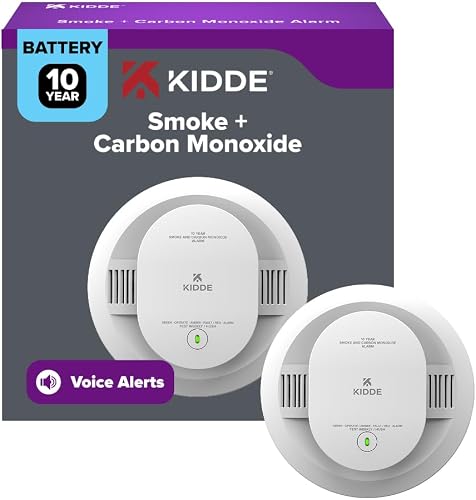
5. Kidde Smoke & Carbon Monoxide Detector: Best for spoken hazard alerts
Kidde Smoke & Carbon Monoxide Detector: Best for spoken hazard alerts
- 1-pack
- Built-in 10-year battery
- 85 dB alarm
- Voice alerts for fire and carbon monoxide
The 30CUD10-V names the hazard with voice messages, saying Fire for smoke and Warning, Carbon Monoxide for CO. Its built-in 10-year battery avoids regular battery replacements.
Pros
- Voice hazard alerts
- Built-in 10-year battery
- 85 dB alarm
Cons
- Single alarm
- No LCD CO reading listed
The Kidde 30CUD10-V is the strongest choice when spoken messages could help you identify the danger quickly. Its voice alert says “Fire” for smoke and “Warning, Carbon Monoxide” when CO is present.
The built-in 10-year battery avoids routine battery replacements and low-battery chirps during its stated battery life. The alarm also provides an 85 dB warning and a red LED for visual notification.
Photoelectric and electrochemical sensors detect smoke and carbon monoxide. Kidde says the sensing technology helps reduce false alarms from cooking or steam, while the alarm is tested to UL 217 10th Edition, UL 2034 5th Edition and FCC standards.
The plastic housing measures 2 in D x 5 in W x 5 in H. The 1-pack includes the alarm, mounting hardware and a user guide.
Choose this model for a bedroom, apartment or home where a spoken hazard message is more useful than an LCD. For replaceable batteries, choose the AA-powered 30CUDR instead.
Sealed battery or AA battery: which is better?
A sealed battery is better when you want fewer maintenance tasks, while AA power is better when you want to replace batteries yourself.
The Heiman, X-Sense SC01, X-Sense SC07 and Kidde 30CUD10-V use 10-year or built-in battery designs, while the Kidde 30CUDR uses two AA batteries.
With a sealed battery, you avoid routine battery changes and low-battery chirps during the stated life. The trade-off is that the whole alarm is replaced when the battery or the alarm itself is spent.
With AA batteries, you can keep spare batteries at home and swap them when needed. The trade-off is that you must remember to replace them and test the alarm after each change.
Sealed battery alarms still need regular testing and eventual replacement. A long battery life does not make an alarm permanent, and the end-of-life warning should be treated as a replacement reminder.
For landlords and busy homeowners, sealed power can reduce the number of small tasks over a decade. For buyers who prefer control over maintenance, replaceable AA batteries may feel more familiar.
Neither option removes the need for proper placement. Battery choice helps with upkeep, but location, testing and timely replacement decide whether the alarm can do its job.
Room size and noise also deserve a thought before you choose. A sealed model with voice alerts or alarm memory may suit a bedroom, while an AA model may suit a hallway where you can reach it easily.
The better choice depends on which chore you prefer to avoid, changing batteries or buying a new alarm.
Do combination alarms detect both hazards?
Yes. A combination smoke and carbon monoxide alarm is designed to detect both smoke and CO in one housing, but the two hazards use different sensing methods.
Smoke sensing watches for particles from a fire, while CO sensing responds to an invisible, odorless gas. Putting both in one unit saves space and makes placement simpler in rooms that need both types of protection.
Read do smoke detectors detect carbon monoxide for the distinction.
Not every smoke-only alarm can detect carbon monoxide. A combination alarm is built for both, which is why the sensor type matters when you compare models.
The products here use photoelectric smoke sensing and electrochemical CO sensing, except where the product details describe the sensors without additional model-specific information.
That pairing is common in these picks because it matches the sensor to the hazard. Photoelectric sensing is used for smoke, and electrochemical sensing is used for CO.
A combination alarm still needs to be placed where smoke and CO are likely to reach it. One housing does not remove the need for correct placement in each required location.
Keep smoke and CO alarms in the locations required by local guidance. Follow the model instructions for testing, cleaning and replacement, since sensors lose reliability over time.
One unit, two hazards is the appeal, but correct placement and upkeep remain essential.
What should you check before installing a battery alarm?
Check the alarm type, battery design, mounting location, room coverage and maintenance instructions before installation.
Confirm that the model's wall or ceiling mounting method fits the surface, and keep the user guide available for testing and end-of-life steps.
For a bedroom or hallway, a loud alarm and a clear visual indicator may matter most. Those rooms are where people sleep, pass quickly or need a warning they can notice without searching for it.
For a larger home, a 3-pack or 5-pack may reduce the need to buy separate units one at a time. It can also keep battery type and alarm style consistent across rooms.
Do not assume that every combination alarm communicates with the others. The X-Sense SC01 and SC07 are standalone models, so they are not substitutes for a wireless-interconnected system.
That means each alarm must be placed and tested on its own. In a larger home, standalone units may still work well, but they will not relay an alert from one room to another.
Always check local guidance for where alarms should go. The safest choice is the one that fits your rooms, your power preference and the instructions for the exact model.
What should you do when an alarm sounds?
Treat every smoke or CO alarm as a safety alert. Leave the area when appropriate, follow your household emergency plan and contact emergency services if there is a fire or suspected carbon monoxide exposure.
Do not silence an alarm by removing its battery. If a Kidde unit produces an unexpected pattern, our guide to Kidde carbon monoxide detector 2 beeps explains why beep patterns need attention.
When an alarm reaches the end of its service life, follow the brand's disposal guidance. Our guide to Kidde carbon monoxide detector disposal covers that next step for Kidde units.
Which battery smoke and carbon monoxide detector should you choose?
Choose the Heiman 3-pack if you need several rooms covered with 10-year sealed-battery alarms.
Choose the X-Sense SC01 for one basic standalone unit, the Kidde 30CUDR for replaceable AA batteries, the X-Sense SC07 for LCD CO readings, or the Kidde 30CUD10-V for spoken hazard alerts.
Each pick solves a different problem. The Heiman 3-pack spreads coverage across rooms, the SC01 keeps a single-room setup simple, and the 30CUDR lets you change AA batteries yourself.
The SC07 adds visible CO information through its LCD, which may help households that want more detail during an event. The 30CUD10-V names the hazard with voice messages, which may help people respond more quickly.
For portable use away from home, compare our guide to the best carbon monoxide detector for camping.
For a fixed home installation, match the alarm type and power design to each room, then follow the model instructions and local safety guidance.
Think about care as well as features. A sealed battery reduces routine chores, while AA power gives you control over replacements at home.
Also think about how you want to be alerted. A siren alone may be enough in some rooms, while an LED, LCD or voice message may be more useful in others.
If you are unsure, start with the rooms where people sleep and the paths they use to leave. Then add coverage for living areas, basements or other spaces as needed.
The right choice is the alarm you can place correctly, test regularly and replace on time. That practical fit matters as much as the headline features.
Our top 3 picks at a glance
-
1
Best for covering several rooms
Heiman Smoke and Carbon Monoxide Detector 10-Year
9.6/10 our score
See it on Amazon -
2
Best for a simple single-room setup
X-Sense Smoke Detector and Carbon Monoxide Detector
9.5/10 our score
See it on Amazon -
3
Best for replaceable AA batteries
Kidde Smoke & Carbon Monoxide Detector
9.5/10 our score
See it on Amazon
Frequently asked questions
What is the best battery smoke and carbon monoxide detector?
The Heiman Smoke and Carbon Monoxide Detector 10-Year is the strongest overall pick here because its 3-pack covers several rooms, uses a 10-year sealed battery, and combines photoelectric and electrochemical sensing.
Choose Kidde for voice alerts or X-Sense for an LCD that shows CO levels.
Are battery smoke and carbon monoxide detectors reliable?
Battery-powered combination alarms can provide smoke and CO detection without electrical rewiring. Look for a clear battery life, smoke and carbon monoxide sensors, a loud alarm, and recognized safety standards such as UL 217 and UL 2034.
Install and maintain each alarm according to its instructions.
Should I choose a sealed battery or AA battery alarm?
A sealed battery alarm avoids routine battery changes for its stated battery life. An AA-powered alarm lets you replace the batteries when needed, which may suit homes that prefer replaceable power.
The Kidde 30CUDR uses two included AA batteries, while the other picks here use sealed or built-in 10-year batteries.
Where should a battery smoke and carbon monoxide detector go?
Mount combination alarms in the rooms and locations required by your local safety guidance, using the supplied mounting hardware and the model's instructions. The products here support wall or ceiling mounting, but placement rules can vary.
Avoid choosing a location only because it is convenient.


