9 Best Kidde Carbon Monoxide Detectors (November 2026)
The best Kidde carbon monoxide detectors include the Kidde Smoke & Carbon Monoxide Detector for hardwired voice alerts, the Kidde Carbon Monoxide Detector for plug-in home coverage, and the Kidde Carbon Monoxide Detector for portable placement.
On this page (7 sections)
- The best Kidde carbon monoxide detectors for different needs
- How we scored these Kidde carbon monoxide detector reviews
- Plug-in, battery or hardwired: which Kidde design fits?
- Do you need smoke and carbon monoxide detection in one unit?
- Where should a Kidde carbon monoxide detector go?
- How should you maintain a Kidde carbon monoxide alarm?
- Verdict: which Kidde carbon monoxide detector should you choose?
The best Kidde carbon monoxide detector for most homes is the plug-in Kidde Carbon Monoxide Detector with AA backup, because it uses a standard 120V outlet and keeps working with two AA batteries during a power outage. For smoke and CO coverage together, choose a hardwired combination model with voice alerts.
Our Kidde carbon monoxide detector reviews compare fixed, portable, hardwired and smart designs. We checked power sources, backup options, alert types, sensor details, placement choices and the daily trade-offs between simple alarms and connected monitoring.
If you also need to understand the difference between smoke and CO protection, start with our guide to what is a smoke alarm. For a broader home comparison, see the best carbon monoxide detector for home.
Our picks at a glance
-
1
 Best for hardwired voice alerts
Kidde Smoke & Carbon Monoxide Detector
9.7/10 our score
See it on Amazon -
2

-
3

- 4
 Check it
Kidde Worry-Free Carbon Monoxide Detector Alarm
Best for no battery changes - 5
 Check it
Kidde Smoke and Carbon Monoxide Detector
Best for modern hardwired upgrades - 6
 Check it
Kidde Hardwired Smoke & Carbon Monoxide Detector
Best for multi-room replacement - 7
 Check it
Kidde Hardwired Smoke & Carbon Monoxide Detector
Best for replaceable backup batteries - 8
 Check it
Kidde Smart Carbon Monoxide Detector
Best for phone notifications - 9
 Check it
Kidde Smart Carbon Monoxide Detector & Indoor
Best for CO and air quality tracking
The best Kidde carbon monoxide detectors for different needs
The best Kidde model comes down to how you power it, and whether you need CO only protection, smoke coverage, phone alerts or a portable design. Hardwired combination alarms suit whole home protection, while plug in and battery models suit simpler fixed or flexible placement.
The top three picks share the same score but serve different installation needs. Choosing by outlet access, ceiling wiring and how often you want to change batteries will narrow the list faster than comparing feature counts alone.
That is the practical starting point for the picks below.
How we scored these Kidde carbon monoxide detector reviews
Our score weighs specs, features and buyer feedback against what you're shopping for. We gave more weight to clear power options, backup coverage, useful alert types, placement flexibility and features that match common home safety needs.
We did not treat a higher feature count as automatically better. A basic battery alarm can be the better choice for a room without an outlet, while a smart alarm may be worth the extra setup if you need notifications when you're away.
For background on alarm performance and the limits of any detector, read how reliable are carbon monoxide detectors. Carbon monoxide is an odorless gas, so an alarm should support a broader safety plan that includes proper appliance care and an exit response.
| Product | Best for | Power | Detection | Model | Our score |
|---|---|---|---|---|---|
| Kidde Smoke & Carbon Monoxide Detector | hardwired voice alerts | 120V hardwired with 9V backup | Photoelectric smoke and electrochemical CO | KN-COPE-IC | 9.7 |
| Kidde Carbon Monoxide Detector | plug-in home coverage | Plug-in with 2 AA backup batteries | KN-COB-DP2 | 9.7 | |
| Kidde Carbon Monoxide Detector | portable placement | 2 AA batteries | KN-COPP-B-LPM | 9.7 | |
| Kidde Worry-Free Carbon Monoxide Detector Alarm | no battery changes | 10-year sealed battery | C3010 | 9.6 | |
| Kidde Smoke and Carbon Monoxide Detector | modern hardwired upgrades | 120V hardwired with 10-year backup | Photoelectric smoke and electrochemical CO | 30CUA10-V | 9.5 |
| Kidde Hardwired Smoke & Carbon Monoxide Detector | multi-room replacement | 30CUA10-V | 9.2 | ||
| Kidde Hardwired Smoke & Carbon Monoxide Detector | replaceable backup batteries | 30CUAR | 9.1 | ||
| Kidde Smart Carbon Monoxide Detector | phone notifications | Plug-in with 2 AA backup batteries | COPDW | 8.6 | |
| Kidde Smart Carbon Monoxide Detector & Indoor | CO and air quality tracking | Plug-in with battery backup | KN-COP-DP-10YL-AQ-WF | 8.5 |
Kidde Smoke & Carbon Monoxide Detector: Best for hardwired voice alerts
- Hardwired 120V power
- 9V battery backup
- 85 dB alarm with voice alerts
- Interconnects with up to 24 Kidde devices
This combination alarm adds voice alerts to hardwired smoke and carbon monoxide coverage. A front battery door and interconnect support make it useful for homes with compatible Kidde wiring.
Pros
- Smoke and CO detection in one unit
- Front-load battery door
- Voice alerts identify the hazard
Cons
- Requires hardwired installation
- Uses a 9V backup battery
The Kidde Smoke & Carbon Monoxide Detector is a strong choice when one hardwired alarm needs to cover both smoke and CO. Model KN-COPE-IC pairs photoelectric smoke detection with electrochemical CO detection, plus an 85 dB alarm and voice alerts that say “Fire!” or “Warning!
Carbon Monoxide!”
It runs from a 120V power source with a 9V battery backup for outages. The front battery door makes battery replacement simpler when the unit is mounted on the ceiling, since you do not need to remove the whole alarm to reach it.
Interconnect support allows up to 24 other Kidde devices, including smoke, CO and heat alarms. That suits a home already wired around compatible Kidde alarms, but wiring and model requirements should be checked before installation.
The voice alerts help people tell which hazard triggered the alarm, which can guide a quicker response. This model suits hardwired ceiling locations and households that want spoken warnings.
It is less suited to portable use, renters who cannot use hardwiring, or homes that only need CO detection in one room.
Kidde Carbon Monoxide Detector: Best for plug-in home coverage
- Plug-in 120V design
- 2 AA battery backup
- 85 dB alarm
- Peak Level Memory
The plug-in format keeps setup simple while two AA batteries provide backup during a power outage. Peak Level Memory and the Test-Hush button add useful day-to-day controls.
Pros
- Simple outlet installation
- AA backup during outages
- Peak Level Memory
Cons
- Needs a suitable outlet
- CO-only detection
The Kidde Carbon Monoxide Detector, model KN-COB-DP2, is an easy fixed install pick for many homes. It plugs into a standard 120V outlet, and two AA battery backup provides coverage during a power outage.
The 85 dB alarm gives a clear audible warning when CO is detected. Peak Level Memory records the last time CO was detected or the unit was tested, which can be useful context after an event or routine check.
The Test-Hush button lets you test operation or temporarily silence a false alarm, so nuisance triggers do not have to run their full course. That control matters in busy homes where testing should stay simple and quick.
This is a CO only detector, so it does not replace a smoke alarm. It suits bedrooms, hallways or other spots where a standard outlet is handy and you want simple setup without hardwired installation.
Choose it when plug in power is the priority and you want a fixed alarm with backup. If you need tabletop or wall placement without an outlet, the battery powered model below is a better match.
Kidde Carbon Monoxide Detector: Best for portable placement
- Battery powered
- 2 AA batteries
- 85 dB alarm
- LED status indicators and Peak Level Memory
This battery-powered alarm works where wiring or an outlet is inconvenient. Its wall or tabletop placement and portable design also make it a practical option for travel.
Pros
- No wiring required
- Wall or tabletop placement
- Peak Level Memory
Cons
- Requires battery changes
- CO-only detection
The Kidde Carbon Monoxide Detector, model KN-COPP-B-LPM, is the best portable option in this group. It uses two AA batteries, needs no wiring and can sit on a tabletop or mount on a wall.
An 85 dB alarm and red LED signal the presence of carbon monoxide, while a green LED indicates power. Peak Level Memory records the last detected CO level or the last test, and the Test-Hush button helps with routine checks and low-battery chirps.
The battery format makes this model flexible during power failures and useful for travel. You will need to keep suitable batteries available and remember that a portable CO alarm still needs a sensible location near the areas it is meant to protect.
Choose it for flexible placement, a room without a convenient outlet or travel use. For a fixed alarm with no routine battery replacement, consider the sealed-battery C3010.
Kidde Worry-Free Carbon Monoxide Detector Alarm: Best for no battery changes
- 10-year sealed lithium battery
- Automatic activation
- Electrochemical sensor
- Event Memory for the previous 14 days
The C3010 is a straightforward CO alarm for buyers who want a sealed battery and no routine battery replacement. Event Memory can show that a high CO event occurred within the previous 14 days.
Pros
- Sealed 10-year battery
- Automatic activation on the bracket
- End-of-life indication
Cons
- No digital display
- Battery is not user replaceable
The Kidde Worry-Free Carbon Monoxide Detector Alarm, model C3010, suits buyers who want a sealed battery and fewer routine tasks. Its lithium power supply is sealed for the 10 year life of the alarm, so there is no battery removal or replacement during that period.
The alarm activates when attached to its mounting bracket, which helps reduce the risk of it sitting unused. A green LED shows normal operation, while a red LED signals dangerous CO levels.
Event Memory flashes to show that a high CO event was detected within the previous 14 days. That simple signal is helpful for homes without a digital display, though it gives less detail than a peak reading.
This model uses an electrochemical sensor and has no digital display. At the end of the alarm life, it chirps to signal replacement, and a screwdriver can deactivate the end of life chirp for disposal.
Choose it for simple fixed CO protection with sealed power. Pick the KN-COB-DP2 instead if you want a plug in format, Peak Level Memory and a Test-Hush button.
Kidde Smoke and Carbon Monoxide Detector: Best for modern hardwired upgrades
- 120V hardwired power
- 10-year built-in battery backup
- Voice alerts
- Interconnect capability
This combination alarm pairs hardwired power with a built-in 10-year battery backup. Voice messages, an 85 dB alarm and interconnect capability help identify and share the alert.
Pros
- Smoke and CO detection
- 10-year built-in backup
- Voice messages identify the hazard
Cons
- Requires hardwired installation
- Interconnect requirements vary by model
The Kidde Smoke and Carbon Monoxide Detector, model 30CUA10-V, is a modern hardwired combination alarm with a built in 10 year battery backup. It uses photoelectric smoke and electrochemical CO sensing, an 85 dB alarm, a red LED and voice messages that identify the hazard.
Its interconnect capability can make multiple compatible Kidde alarms sound when one detects danger. That whole home response is valuable in larger homes where a single alarm may not be heard everywhere.
The model is designed for 120V AC power, so installation depends on suitable wiring and following the user guide. The built in backup avoids routine battery changes for the stated backup period, which suits owners who want fewer maintenance tasks.
Kidde describes enhanced sensing intended to reduce false smoke alarms caused by cooking or steam. That does not remove the need for sensible placement, but it can make a kitchen nearby location easier to manage.
Choose it for a hardwired upgrade where voice alerts and long term backup matter. If you need several units at once, the 4 pack uses the same model number and offers a different quantity.
Kidde Hardwired Smoke & Carbon Monoxide Detector: Best for multi-room replacement
- 4-pack
- 120V hardwired power
- 10-year built-in battery backup
- Voice alerts and interconnect capability
The 4-pack is suited to a home replacing several combination alarms at once. Each unit uses hardwired power, a built-in 10-year backup and voice alerts.
Pros
- Four alarms in one pack
- No routine battery changes
- Smoke and CO detection
Cons
- Needs compatible hardwired locations
- Larger quantity may exceed a small home's needs
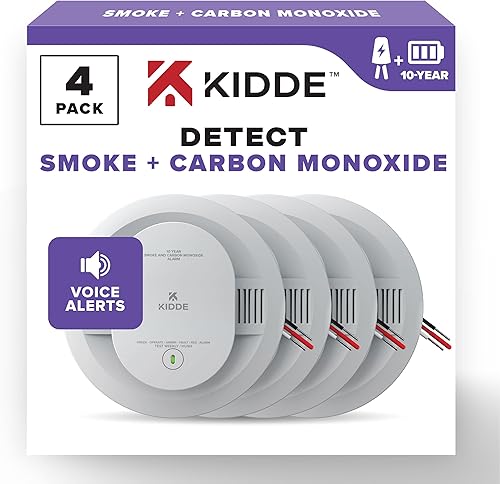
The Kidde Hardwired Smoke & Carbon Monoxide Detector, model 30CUA10-V, is the best quantity choice for replacing several alarms at once. The pack includes 4 alarms, mounting hardware and a user guide.
Each alarm uses 120V AC wiring and a built in 10 year battery backup. Photoelectric smoke detection, electrochemical CO detection, voice alerts and interconnect capability cover the main features of the single unit version.
A 4 pack makes sense when you need coverage across several levels, hallways or sleeping areas. Buying one pack for a coordinated replacement can also keep the alarm models consistent across the home.
It can be more than you need for a smaller space, and hardwired installation still requires compatible locations. Interconnection requirements vary by model, so the user guide should be checked before wiring alarms together.
Choose this pack when you are planning a coordinated replacement. For two locations with replaceable backup batteries, the 2 pack below offers a different power strategy.
Kidde Hardwired Smoke & Carbon Monoxide Detector: Best for replaceable backup batteries
- 2-pack
- 120V hardwired power
- 2 AA backup batteries
- LED status lights and Test-Hush button
This 2-pack combines hardwired smoke and CO detection with replaceable AA backup batteries. Green, amber and red LEDs show normal, error and alarm states.
Pros
- Two combination alarms
- Replaceable AA backup
- LED status indicators
Cons
- Requires hardwired installation
- Backup batteries need periodic replacement
The Kidde Hardwired Smoke & Carbon Monoxide Detector, model 30CUAR, suits buyers who want hardwired combination alarms with replaceable backup batteries. This 2-pack uses 120V AC wiring and two AA alkaline batteries per alarm for outage coverage.
Green, amber and red LEDs show normal operation, an error and smoke or CO detection. For the ERR display, see why a Kidde detector shows ERR.
The 85 dB alarm, Test-Hush button and self-testing function support routine checks, but the manufacturer still says to perform a manual button test each week.
The batteries should be replaced every 6 months or when the alarm gives a low-battery chirp. That makes this model easier to maintain than a sealed-battery design in one way, but it adds a recurring care task.
Choose it when you want two combination alarms and control over the backup batteries. For no routine battery changes, compare the 10-year built-in backup models.
Kidde Smart Carbon Monoxide Detector: Best for phone notifications
- Kidde app notifications
- 2.4 GHz Wi-Fi
- Plug-in power with 2 AA backup batteries
- Alexa and Google Home integration
The COPDW suits homeowners and renters who want CO alerts while away from home. It connects through 2.4 GHz Wi-Fi and works with the Kidde app without a subscription.
Pros
- Real-time app notifications
- Digital backlit display
- Rotating plug for outlet orientation
Cons
- Needs 2.4 GHz Wi-Fi
- Smart features add setup steps
The Kidde Smart Carbon Monoxide Detector, model COPDW, is the best Kidde choice for phone notifications while you are away. It plugs into a standard outlet, uses two AA backup batteries and connects to the Kidde app through 2.4 GHz Wi-Fi.
The app sends real-time CO notifications, while the alarm provides an 85 dB audible warning. A backlit digital display shows event status and alarm operation, and the rotating plug fits vertical or horizontal outlets.
Setup requires downloading the app, scanning the QR code on the alarm and connecting it to a compatible network. Alexa and Google Home integration adds another way to check status, but the smart features are less useful if your home Wi-Fi is not available.
Choose it for connected CO monitoring in a home or apartment. If you also want TVOC and humidity monitoring, the indoor air quality model offers a wider set of measurements.
Kidde Smart Carbon Monoxide Detector & Indoor: Best for CO and air quality tracking
- CO and indoor air quality monitoring
- Wi-Fi app alerts
- Voice alerts
- TVOC and humidity monitoring
This smart model adds TVOC and humidity monitoring to carbon monoxide detection. It suits connected homes where indoor air information matters alongside a CO alarm.
Pros
- CO and indoor air quality monitoring
- App and voice alerts
- Alexa and Google Home compatibility
Cons
- More features than a basic CO alarm
- Requires app setup and a compatible smart device
The Kidde Smart Carbon Monoxide Detector & Indoor Air Quality Monitor adds indoor air quality monitoring to CO protection. Model KN-COP-DP-10YL-AQ-WF monitors carbon monoxide, TVOCs and humidity, then sends information through the Kidde app.
It plugs into a standard outlet and includes battery backup for outages. Voice alerts identify CO with a “Warning Carbon Monoxide” message, while the unit can also announce when it needs replacement.
The app can send alerts for CO, humidity, temperature and TVOCs. That wider view can help a household notice patterns from cleaning products, paint or damp conditions, alongside the core CO alarm function.
Alexa, Google Home, iPhone and Android compatibility make it a fit for a connected home. The trade off is added setup and more information than a basic alarm provides, which may not suit every buyer.
Choose this model when indoor air information matters alongside carbon monoxide detection. For a simpler smart alarm with a digital display and phone alerts, the COPDW is easier to match to that goal.
Plug-in, battery or hardwired: which Kidde design fits?
A plug-in Kidde alarm is the simplest fixed option when a standard 120V outlet is in the right location. The KN-COB-DP2 adds two AA backup batteries, while the smart COPDW adds app notifications and needs 2.4 GHz Wi-Fi.
A battery-powered model gives you the most placement flexibility. The KN-COPP-B-LPM can sit on a tabletop or mount on a wall, but its batteries become part of your regular care routine.
Hardwired combination alarms make more sense when you need both smoke and CO detection or want compatible alarms to sound together. They require suitable wiring, and interconnect rules vary by model, so follow the user guide and local installation requirements.
Do you need smoke and carbon monoxide detection in one unit?
A combination alarm is useful when you want smoke and CO detection from one ceiling mounted device. Kidde combination models here use photoelectric smoke sensors and electrochemical CO sensors, with options for voice alerts, LEDs, battery backup and interconnection.
That single device format can reduce clutter on the ceiling and simplify replacement when an older combo alarm reaches the end of its life. It only works well if the location suits both hazards, and if the alarm is installed according to the manufacturer instructions and local requirements.
A CO only alarm still has a clear role in rooms where you need carbon monoxide protection without replacing an existing smoke alarm. Many homes need both types in different places, so it helps to map existing coverage before deciding on a replacement.
Photoelectric smoke detection is designed for visible fire particles, while electrochemical CO detection responds to carbon monoxide gas. In daily use, that means one unit can stand guard for two very different risks, but it does not make placement less important.
Voice alerts can add clarity in a combination alarm, since they name the hazard instead of only sounding a tone. LEDs and interconnect options can also help, especially in larger homes where several alarms need to respond together.
Battery backup is another point to compare, because hardwired combo alarms may use a 9V battery, replaceable AA batteries or a built in 10 year backup. The right choice depends on how much routine battery care you want to handle.
Match the alarm type to the coverage already in your home rather than assuming one device covers every safety need. A combo alarm in a hallway may still need separate care in bedrooms, living areas or other levels.
For a focused comparison of combination Kidde units, read our guide to the best Kidde carbon monoxide and smoke detector.
Where should a Kidde carbon monoxide detector go?
Place alarms according to the manufacturer instructions and your local safety requirements, with attention to sleeping areas and each level of the home. The right spot depends on the model, because a hardwired ceiling alarm, a plug in unit and a portable battery alarm are not placed the same way.
For CO protection, locations near where people sleep and on each level are a common starting point. Keep the alarm accessible for testing and battery care, and follow the guidance for the specific Kidde model you install.
Do not cover its openings, block its sound or place it where routine cooking, steam or other conditions may cause repeated nuisance alarms. A blocked or poorly sited alarm is less useful, even if the model itself is well suited to the home.
Plug in models need a suitable outlet that stays in use, while hardwired models need compatible ceiling wiring. Portable battery models can move between rooms, but they still need a sensible fixed spot rather than being left where they are easiest to carry.
If you need protection for a vehicle or travel setup, see the best carbon monoxide detector for car guide. A portable battery model can be convenient, but the correct placement depends on the space and the alarm instructions.
How should you maintain a Kidde carbon monoxide alarm?
Test the alarm with its test button as directed, replace batteries when required and respond to low battery or end of life warnings. A weekly manual button test is specifically noted for the 30CUAR combination alarm, and replaceable backup batteries need regular attention.
Keep the alarm free from dust and damage, and check that nothing blocks its sound or sensor openings. If an alarm is mounted high or in an awkward spot, plan how you will reach it safely for testing and battery changes.
Sealed battery models reduce battery changes but still need replacement when the alarm reaches the end of its stated life. An end of life chirp is a signal to replace the unit, not simply to silence it and leave it in place.
Smart models also need their app and Wi-Fi connection checked so phone alerts remain useful. A smart alarm that is offline may still sound locally, but the remote notification benefit depends on the connection staying active.
For replaceable backup batteries, follow the stated replacement interval or the low battery chirp, whichever comes first. Homes with several alarms can benefit from a simple routine, such as checking batteries and testing alarms on the same schedule.
If an alarm sounds for carbon monoxide, leave the area and follow your household emergency plan. Do not silence the alarm and stay inside to investigate the source.
Keep a note of when alarms were installed, since warranty and replacement timing can depend on when the alarm was first powered on. That record also makes a whole home replacement easier to plan.
Verdict: which Kidde carbon monoxide detector should you choose?
The Kidde Carbon Monoxide Detector with AA backup is the best starting point for most homes that want simple plug in CO protection. It uses a standard outlet for daily power and AA batteries for backup during an outage, which covers the most common fixed location need without hardwired installation.
Choose the KN-COPP-B-LPM for portable battery placement on a wall or tabletop. That format suits a room without a convenient outlet, a temporary setup or travel, though it does require battery changes and a thoughtful location.
Choose the C3010 for a sealed 10 year battery and no routine battery replacement. It is a straightforward CO only option where fewer maintenance tasks matter more than a digital display or Peak Level Memory.
Choose the KN-COPE-IC or 30CUA10-V for hardwired smoke and CO coverage. The KN-COPE-IC adds voice alerts and interconnect support with a 9V backup, while the 30CUA10-V adds a built in 10 year backup and a modern hardwired design.
Choose the COPDW when phone alerts matter while you are away from home. It needs 2.4 GHz Wi-Fi and the Kidde app, but it adds real time notifications that a basic alarm cannot provide.
Choose the Smart Carbon Monoxide Detector & Indoor Air Quality Monitor when TVOCs and humidity belong in the same system as CO detection. It is a wider monitoring tool, so it fits connected homes better than buyers who only want a basic alarm.
The right Kidde carbon monoxide detector reviews best when you match the power type, coverage and maintenance needs to your home. Start with the location and power source, then add smoke detection, interconnect or smart alerts only where they solve a real need.
Our top 3 picks at a glance
-
1
Best for hardwired voice alerts
Kidde Smoke & Carbon Monoxide Detector
9.7/10 our score
See it on Amazon -
2
-
3
Frequently asked questions
Which Kidde carbon monoxide detector is best for most homes?
The plug-in Kidde Carbon Monoxide Detector with 2 AA battery backup is the best fit for many homes because it installs at a standard 120V outlet and continues operating during a power outage. Choose a hardwired combination alarm if you also need smoke detection and interconnect support.
What is the difference between the Kidde KN-COB-LP2 and KN-COB-DP2?
The KN-COB-DP2 is a plug-in Kidde carbon monoxide detector with 2 AA battery backup, an 85 dB alarm and Peak Level Memory. Check the exact model number before ordering because similar Kidde names can describe different power and placement formats.
Are Kidde carbon monoxide detectors portable?
Some are. The battery-powered Kidde Carbon Monoxide Detector with model KN-COPP-B-LPM can sit on a tabletop or mount on a wall, while plug-in and hardwired models are better suited to fixed locations.
Battery-powered placement is useful when an outlet or wiring is not convenient.
Should you buy a smoke and carbon monoxide combo alarm?
A combo alarm can be useful when you need smoke and CO detection in one device. Hardwired Kidde combination models in this guide use photoelectric smoke detection and electrochemical CO detection, with options for voice alerts, battery backup and interconnection.
How often should you test a Kidde carbon monoxide detector?
Use the Test or Test-Hush button according to the alarm's instructions and keep the unit's power source in good condition. A test verifies the alarm function at that moment, but it does not replace proper placement, battery care or replacement at the end of the alarm's stated life.