9 Best Carbon Monoxide Detectors for Garages (November 2026)
The best carbon monoxide detectors for garages include the Kidde Carbon Monoxide Detector for a wall or tabletop, the Kidde Carbon Monoxide Detector for an outlet with backup, and the Kidde Carbon Monoxide Detector for battery operation.
On this page (7 sections)
- Which carbon monoxide detectors for garages suit different needs?
- What should you check before putting a CO detector in a garage?
- Is a portable CO detector enough for garage safety?
- Which power type works best in a garage?
- Should you choose a combo smoke and CO alarm?
- How did we choose these garage CO detector picks?
- Which garage CO detector should you choose?
The best carbon monoxide detector for a garage is one approved for the garage's conditions and installation location. A home alarm's features do not mean it can handle a garage's heat, cold, dust or moisture.
Choose a fixed CO alarm for ongoing protection only where the product instructions and local rules permit it. A handheld meter can help with spot checks, but it does not replace a fixed alarm.
We compared the listed features and focused on how each type may fit garage planning.
Our picks at a glance
-
1

-
2

-
3

- 4
 Check it
X-Sense Smoke Detector Carbon Monoxide Detector Combo
Best for combined smoke and CO - 5
 Check it
Kidde Smoke & Carbon Monoxide Detector
Best for a battery-powered combo - 6
 Check it
TOPTES CT-580 Portable Carbon Monoxide Detector
Best for portable CO spot checks - 7
 Check it
Siterlink Carbon Monoxide Detectors Plug
Best for plug-in backup power - 8
 Check it
X-Sense Smoke Detector and Carbon Monoxide Detector
Best for multiple combo alarms - 9
 Check it
TopTes S2 Multi Natural Gas Detector
Best for portable gas checks
Which carbon monoxide detectors for garages suit different needs?
The best choice depends on whether you need a fixed alarm, a smoke and CO combination, or a portable meter for spot checks. Confirm approved installation conditions first, then compare power and detection features.
Kidde Carbon Monoxide Detector: Best for a wall or tabletop
- 10-year lithium battery
- Digital CO display updates every 15 seconds
- 85 dB alarm
- Peak Level Memory
A sealed 10-year battery and digital display suit buyers who want a standalone alarm. Confirm the installation location is allowed by the manual.
Pros
- No wiring needed
- Digital display and Peak Level Memory
- Detects during a power failure
Cons
- Approved garage conditions need confirmation
- Not a portable spot-check meter
This Kidde model is a strong fit when you want a standalone alarm without wiring. Its 10-year lithium battery can keep it operating during a power failure, and its digital display updates the CO level every 15 seconds.
The green, red and amber LEDs indicate normal operation, detected CO and replacement status. Peak Level Memory records the last time CO was detected or the unit was tested.
It can be mounted on a wall or placed on a tabletop. Those options describe the device, but they do not confirm that a particular garage location is allowed; check the instructions and temperature limits.
Choose it for an approved location where battery operation and a digital reading matter. For a home-focused comparison, see our best carbon monoxide detector for home.
Kidde Carbon Monoxide Detector: Best for an outlet with backup
- Plugs into a standard 120 V outlet
- Two-AA battery backup
- 85 dB alarm
- Peak Level Memory
This plug-in alarm adds two-AA backup for a power outage. Use it only where its instructions allow, with an outlet that suits the installation.
Pros
- Simple plug-in setup
- Battery backup
- Test-Hush button
Cons
- Needs a suitable outlet
- Approved garage conditions need confirmation
This Kidde is suited to an approved spot with a compatible standard 120 V outlet. Two AA batteries provide backup during a power outage, while the audible alarm sounds at 85 dB.
Peak Level Memory records the last CO detection or test, and the Test-Hush button supports testing or silencing false alarms. Its plug-in design makes outlet access part of the placement decision.
Check whether the outlet and surrounding conditions meet the alarm's instructions. For more about the brand's options, see our best X-Sense carbon monoxide detector guide.
Kidde Carbon Monoxide Detector: Best for battery operation
- Runs on two AA batteries
- Electrochemical sensor
- 85 dB alarm
- Peak Level Memory
Battery power avoids wiring and provides operation during an outage. Check the manual's approved locations and temperature limits before choosing a garage spot.
Pros
- No wiring needed
- Portable wall or tabletop design
- Peak Level Memory
Cons
- Batteries need attention
- Approved garage conditions need confirmation
This battery-powered Kidde alarm works without wiring and uses two AA batteries. It has an electrochemical sensor, an 85 dB alarm, a red warning LED and Peak Level Memory.
Its wall-mount or tabletop design also makes it portable between suitable locations. The stated 10-year limited warranty applies to the alarm, not battery performance, and the start date depends on when the alarm is powered on.
Use it only where the manufacturer instructions permit, including the temperature and humidity conditions. If you're weighing alarm dependability, read how reliable carbon monoxide detectors are.
X-Sense Smoke Detector Carbon Monoxide Detector Combo: Best for combined smoke and CO
- Smoke and CO detection
- 10-year sealed battery
- Photoelectric smoke and electrochemical CO sensors
- Standalone unit
This standalone combo alarm covers smoke and CO in one unit. It has no wireless interconnection, Wi-Fi or base station connection.
Pros
- Two types of detection
- No rewiring
- Sealed battery
Cons
- Not wirelessly interconnected
- Approved garage conditions need confirmation
The X-Sense SC07 combines smoke and CO detection in a standalone alarm. It has a sealed 10-year battery, photoelectric smoke sensing and electrochemical CO sensing.
The unit mounts on a wall or ceiling without rewiring. It does not support wireless interconnection, Wi-Fi or a base station, so it won't share alerts with compatible networked alarms.
For phone notifications, compare CO alarms with app alerts.
This combo can make sense if both smoke and CO detection are needed in an approved location. Check the manual before installing it in a garage, and see our smoke alarm buying guide for help comparing alarm types.
Kidde Smoke & Carbon Monoxide Detector: Best for a battery-powered combo
- Smoke and CO detection
- Two AA batteries included
- 85 dB alarm
- Photoelectric and electrochemical sensors
This battery-powered combo provides smoke and CO detection in one device. Confirm the installation location is approved before using it in a garage.
Pros
- Two types of detection
- No wiring needed
- Red LED warning
Cons
- Batteries need replacement
- Approved garage conditions need confirmation
Kidde's 30CUDR combines smoke and CO detection and runs on two included AA batteries. The 85 dB alarm and red LED provide audible and visual alerts.
Its photoelectric and electrochemical sensors cover the two hazards in one unit. Kidde says its sensing design helps reduce false alarms from everyday cooking or steam, but that feature doesn't determine whether the alarm is suited to a garage.
Check the instructions for approved locations and conditions before mounting it. For smoke-specific choices, compare our best smoke detector for a kitchen area and best photoelectric smoke detector for a kitchen guides.
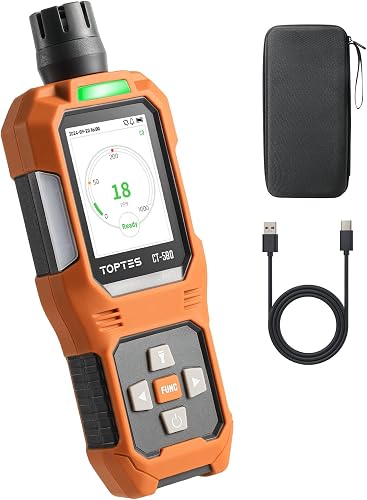
TOPTES CT-580 Portable Carbon Monoxide Detector: Best for portable CO spot checks
- Portable rechargeable meter
- CO range of 0–1000 PPM
- Audible, visual and vibration alarms
- USB-C charging
The CT-580 is a handheld inspection tool with audible, visual and vibration alarms. Its portable design suits checking conditions, not replacing a fixed alarm.
Pros
- Three alarm modes
- Rechargeable by USB-C
- Color display
Cons
- Not intended as a fixed alarm
- Requires charging
The TOPTES CT-580 is a portable inspection tool, not a fixed alarm. It measures CO from 0 to 1000 PPM and offers indicator light, audible and vibration alerts.
Its color display, adjustable brightness, built-in flashlight and USB-C charging support handheld checks. For fixed workplace coverage, compare industrial carbon monoxide detectors.
The product is described for inspection use, so don't rely on it to provide continuous monitoring while you are away.
Choose it to check conditions alongside a suitable fixed alarm, not as a substitute for one. Follow its manual for operation and calibration.
Siterlink Carbon Monoxide Detectors Plug: Best for plug-in backup power
- AC plug-in operation
- 10-year battery backup claim
- Electrochemical sensor
- Foldable plug
This compact plug-in alarm includes a claimed 10-year battery backup. Check its manual for approved conditions and garage placement before relying on it there.
Pros
- Plug-in setup
- Battery backup
- Foldable plug
Cons
- Needs a suitable outlet
- Approved garage conditions need confirmation
The Siterlink alarm plugs into AC power and includes a claimed 10-year battery backup. Its electrochemical sensor and foldable plug suit buyers who want a compact plug-in design.
The product description gives no temperature range or specific garage placement instructions. Confirm those details and local requirements before installing it in a garage.
This model may suit a location with a suitable outlet if the instructions approve the conditions. The backup feature alone doesn't guarantee garage suitability.
X-Sense Smoke Detector and Carbon Monoxide Detector: Best for multiple combo alarms
- Five standalone smoke and CO alarms
- 10-year sealed batteries
- 85 dB alarms
- No wireless interconnection
The five-pack can cover several approved locations with smoke and CO detection. These standalone units do not support Wi-Fi, a base station or wireless interconnection.
Pros
- Five alarms in one pack
- Smoke and CO detection
- No rewiring
Cons
- Not wirelessly interconnected
- Approved garage conditions need confirmation
This X-Sense five-pack gives you five smoke and CO combo alarms, each with a sealed 10-year battery. The SC01 is a standalone model with no wireless interconnection, Wi-Fi or base station support.
The photoelectric and electrochemical sensors provide smoke and CO detection, and the alarms sound at 85 dB. Use the pack to cover multiple approved locations, but verify that each planned spot meets the unit's instructions.
For a long-life combo option, you can also compare our best 10-year smoke and carbon monoxide detector guide.
TopTes S2 Multi Natural Gas Detector: Best for portable gas checks
- Portable combustible gas and CO detector
- Extendable probe for combustible gas checks
- Visual and audible alarms
- Not intended for continuous monitoring
The S2 Multi checks CO and combustible gases with a portable meter. It is designed for spot checks, not continuous, 24-hour monitoring.
Pros
- Checks CO and combustible gases
- Extendable probe for gas leak checks
- Rechargeable
Cons
- Not a fixed CO alarm
- Needs a 30-second warm-up in clean air
The TopTes S2 Multi checks for carbon monoxide and combustible gases, including natural gas and propane. Its extendable probe is for combustible gas checks, while CO readings are intended for ambient spot checks.
This is a portable inspection tool, not a fixed 24-hour alarm. It needs a 30-second warm-up in clean air before detection, and it offers visual and audible alerts.
Use it when you need to inspect a specific area, then rely on an appropriate fixed alarm for ongoing alerts. If you're unsure whether your home needs an alarm, read do I need a carbon monoxide detector?.
What should you check before putting a CO detector in a garage?
Check the manual's approved locations and operating conditions before installing any CO detector in a garage. Temperature, humidity and mounting rules vary by model, so a feature such as a sealed battery or plug-in power doesn't answer the placement question.
Start with the garage's seasonal temperature range, including heat near the ceiling and cold near an exterior wall. Compare that with the manufacturer's allowed range, and confirm any limits for humidity or non-condensing moisture.
Next, follow the unit's mounting instructions and local fire or building requirements. If the alarm's instructions don't clearly allow a garage location, contact the manufacturer or choose an approved location in the home.
Is a portable CO detector enough for garage safety?
A portable CO detector is useful for a spot check, but it isn't a substitute for a fixed alarm. The TOPTES S2 Multi is explicitly not intended for continuous monitoring, and the CT-580 is described as a handheld inspection tool.
A portable reading represents the place and time you checked. It doesn't alert you later if conditions change when the device is switched off or elsewhere.
If you use a portable meter, follow its warm-up, calibration and operating instructions. Keep a fixed alarm installed in an approved location for ongoing alerts.
Which power type works best in a garage?
The best power type is the one that fits an approved location and maintains operation during likely outages. Battery alarms avoid reliance on a nearby outlet, while plug-in alarms need a compatible outlet and may include battery backup.
A sealed battery can reduce routine battery changes, but check its full service life and replacement instructions. Replace the whole alarm when its service life ends, as directed by the manufacturer.
For plug-in models, make sure the outlet remains accessible and doesn't create a placement conflict. A battery backup helps during power loss only if the alarm is installed in an approved environment.
Should you choose a combo smoke and CO alarm?
Choose a combo alarm if you need both smoke and CO detection in the same approved location. A combo unit doesn't remove the need to follow placement rules for each hazard, and a garage may have different conditions from the living areas where household alarms are commonly installed.
Review the product instructions for the exact mounting location and conditions. For a general comparison of CO alarms for living spaces, see our best carbon monoxide detector for home guide.
How did we choose these garage CO detector picks?
We compared the product features provided for these models and matched them to fixed alarm use, combo detection and portable inspection. The list includes a range of power styles and intended uses, while the scores reflect how well each product's described features fit those needs.
Our score weighs specs, features and buyer feedback against what you're shopping for. The product information does not mean any particular model is approved for every garage, so verify the manual and applicable local rules before installation.
Which garage CO detector should you choose?
Choose a fixed alarm only if its instructions approve the garage conditions and placement. Pick the Kidde 10-year battery model for a standalone alarm with a display, an outlet model if backup power and a suitable socket matter, or a portable meter for spot checks.
For smoke and CO in one device, compare the X-Sense and Kidde combo options and confirm garage approval first. If you can't verify the conditions, place a suitable alarm in an approved area of the home and consult local guidance.
Our top 3 picks at a glance
-
1
-
2
-
3
Frequently asked questions
Can you install a carbon monoxide detector in a garage?
Only install a detector in a garage if its instructions and local requirements allow that location. Check the approved temperature and humidity conditions, mounting position, and any distance rules.
A detector made for home use does not automatically suit a garage's heat, cold, dust or moisture.
Where should a carbon monoxide detector go near a garage?
Follow the detector instructions and local code for placement. If the garage connects to the home, check whether an alarm is required near the connecting door or on nearby levels.
Don't assume the garage itself is an approved spot for a household alarm.
Can a portable CO meter replace a fixed alarm?
No. A portable meter is for spot checks, while a fixed alarm is designed to remain in place and alert you.
The TopTes S2 Multi is explicitly not intended for continuous monitoring.
Use the right device for each job, and follow its instructions.
Do smoke and carbon monoxide alarms do the same job?
No. A smoke alarm detects smoke, while a CO alarm detects carbon monoxide.
A combo unit includes both types of detection in one device, but placement rules may differ by hazard and location.
Our smoke alarm guide explains the difference and what to consider.


